Advancing Material Science for Coatings and Adhesives Applications
Unmet needs are driving product innovation in Coatings and Adhesives, two key segments of the “CASE” market (Coatings, Adhesives, Sealants and Elastomers). Product formulators are seeking improved performance on challenging substrates—from achieving an even surface finish on mixed materials to improving adhesion in demanding applications, such as biosensors adhering to wet skin. Many premium consumer and industrial products rely on advanced silane, acrylate and silicone ingredients to improve adhesion and performance at the molecular level.
These specialty chemicals can be applied to material surfaces or incorporated into formulations to modify interfacial properties and enhance final product performance.
At Gelest, we develop and manufacture a broad portfolio of standard and custom silanes, silicones and acrylates to enable innovation across Coatings, Adhesives and other industries. Our expertise in manufacturing, analytical characterization and custom synthesis allows us to help customers accelerate development and bring next-generation technologies to market.
Market Highlights
Coatings and adhesives manufacturers are navigating a range of economic and regulatory challenges that continue to drive formulation changes. Raw material volatility, unpredictable costs and supply chain disruptions for critical inputs such as resins, solvents and titanium dioxide remain significant concerns, further complicated by tariffs and geopolitical uncertainty.
At the same time, formulators must navigate evolving regulatory requirements across global markets, including limits on volatile organic compounds (VOCs) and the phaseout of substances such as PFAS. Growing demand for more sustainable, consumer-friendly products adds another challenge, as reformulation must be achieved without compromising critical performance.
Together, these pressures are increasing demand for materials that provide greater functionality and formulation flexibility while helping manufacturers adapt to changing market requirements.
Technology Highlights
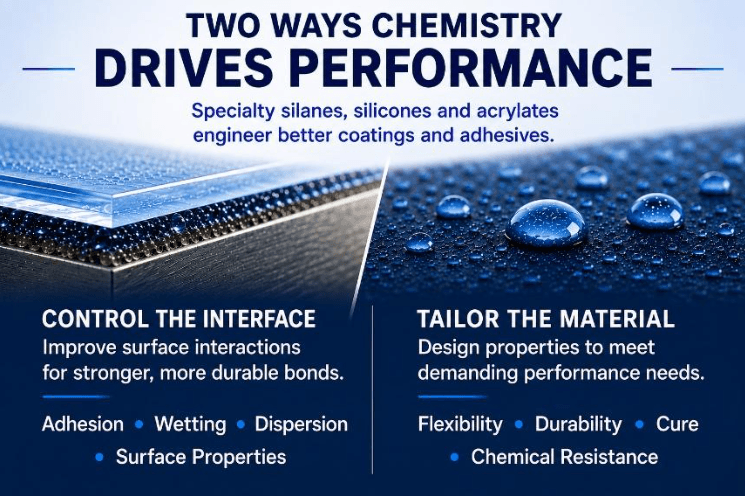
Specialty chemistries provide coatings and adhesives formulators with additional tools to address evolving performance and formulation requirements. Advances in functional silanes, silicones and acrylates can enhance performance through two primary areas:
1) Surface Modification and Interfacial Control
Silane coupling agents can act as molecular bridges between inorganic surfaces or fillers and organic polymers, improving interfacial adhesion and durability. Surface properties can also be tailored to improve wetting and dispersion or provide varying degrees of hydrophobicity, hydrophilicity or oleophobicity.
2) Specialized Performance Additives
Reactive silicones and specialty acrylates can be used to tailor properties such as crosslinking, flexibility, chemical resistance and durability, while metal-organic catalysts can help control formulation cure rates. These chemistries can also enable specialized properties such as scratch resistance, thermal conductivity and optical clarity.
Gelest supports these formulation challenges with a broad portfolio of functional materials, along with custom synthesis, surface modification expertise and high-purity raw materials to help customers optimize adhesion, durability, dispersion and other critical performance characteristics.
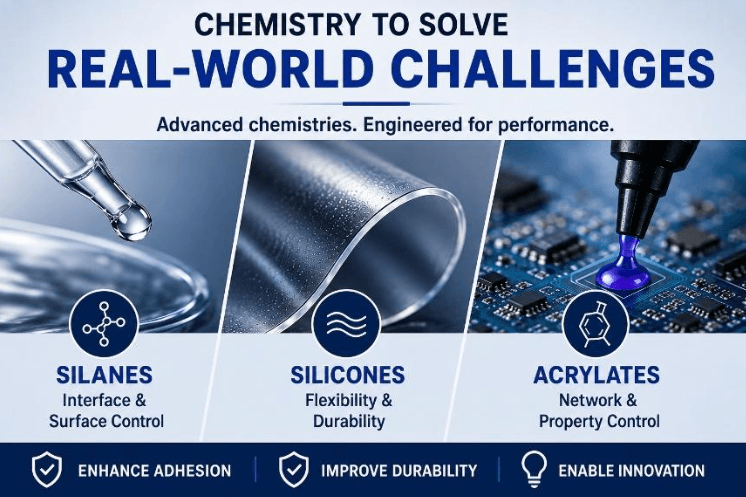
Silanes
Functional silanes offer formulators considerable flexibility in tailoring interactions between organic resin systems and inorganic surfaces. Amino-functional silanes are widely used with epoxy, phenolic, polyurethane and polyamide systems to promote strong interfacial bonding. One of the most widely used is
3-Aminopropyltriethoxysilane (SIA0610.0), which can improve adhesion to substrates such as metals and glass. Other structures provide different reactivity or processing characteristics. For example, 3-Aminopropylmethyldiethoxysilane can be used as a coupling agent or for surface modification where high-density amine functionality is desired.
Epoxy-functional silanes provide another approach for improving interactions between organic resins and inorganic surfaces or fillers. (3-Glycidoxypropyl)trimethoxysilane (SIG5840.0) and its triethoxy counterpart SIG5839.0 are established coupling agents for systems involving materials such as glass and ceramics.
For free-radical and UV-curable systems, acrylate- and methacrylate-functional silanes introduce polymerizable functionality while providing the benefits of silane surface chemistry. Methacryloxypropyltrimethoxysilane (SIM6487.4) is a versatile example used across coatings, adhesives and composite applications.
Isocyanate-functional silanes offer additional opportunities in polyurethane and other systems containing hydroxyl- or amine-functional materials. Products such as 3-Isocyanatopropyltrimethoxysilane (SII6456.0) and 3-Isocyanatopropyltriethoxysilane (SII6455.0) combine reactive isocyanate functionality with hydrolyzable alkoxysilane groups, providing a route to integrate organic and inorganic chemistries within a formulation.
For applications requiring greater interfacial stability and durability, SIVATE™ silane technologies and dipodal silanes provide more specialized options. Dipodal structures contain multiple silicon-containing anchoring groups, which can increase the number of potential interactions with a surface and improve resistance to demanding environmental conditions. Examples include 1,10-Bis(trimethoxysilyl)decane (SIB1829.0) and 1,8-Bis(triethoxysilyl)octane (SIB1824.0).
Silicones
Reactive silicones provide formulators with a way to combine functional organic groups with the flexibility and durability associated with a siloxane backbone. Alkoxy-functional silicones can participate in moisture-driven condensation and crosslinking, while epoxy-functional silicones provide additional compatibility and reactivity with organic resin systems.
For example, Epoxyproxypropyl Terminated Polydimethylsiloxane and DMS-E09 provide epoxy functionality on silicone structures and can be used to modify properties such as adhesion, flexibility and chemical resistance. For applications requiring a more defined molecular structure, 1,3-Bis[2-(3,4-epoxycyclohexyl)ethyl] tetramethyldisiloxane combines cycloaliphatic epoxy functionality with a siloxane structure, providing a versatile building block for specialty coating and adhesive formulations.
Acrylates
Acrylates and methacrylates provide formulators with extensive flexibility in designing polymer networks for coatings and adhesives. Depending on their functionality and molecular structure, they can influence properties ranging from adhesion and crosslink density to flexibility, wetting, chemical resistance and UV stability.
Gelest offers specialty acrylates representing this range of functionality. Beta-carboxyethyl acrylate, for example, provides carboxyl functionality useful in pressure-sensitive and other adhesive systems, while Bisphenol A dimethacrylate can contribute increased crosslink density, toughness and chemical resistance. Polyethoxylated materials such as Behenylpolyethoxy (25) methacrylate and Lauryl polyethoxy (23) methacrylate provide additional options for modifying compatibility, flexibility and interfacial properties.
Other functional structures can address more specialized requirements. N,N-Diethylaminoethyl methacrylate provides reactive amine functionality, while 2-(4-Benzoyl-3-hydroxyphenoxy)ethyl acrylate introduces UV-absorbing functionality for applications where resistance to light-induced degradation is important.
Application Opportunity: Engineering Silicone Materials for Demanding Coatings
Coatings designed for harsh environments can require a difficult balance of durability, surface properties, compatibility, processing, and long-term performance. Standard materials
may provide a starting point, but increasingly demanding applications can require greater control over polymer structure and properties.
Gelest can work with formulators to tailor silicone materials around specific application requirements, including molecular weight, functionality, viscosity, compatibility, and cure characteristics. Development can range from identifying an existing material within Gelest’s portfolio to modifying established chemistry or developing a custom polymer.
Beyond molecular design, Gelest’s analytical, scale-up, manufacturing, and quality capabilities provide a path from laboratory evaluation to commercial supply, allowing material performance, manufacturability, consistency, and supply considerations to be addressed throughout development.
Looking Forward
Coatings and adhesives manufacturers continue to respond to evolving performance, sustainability and regulatory requirements, creating demand for new ways to achieve greater functionality without compromising critical performance. Advances in silanes, silicones and acrylates will provide additional tools to tailor interfaces, improve durability and enable new formulation approaches.
Continued innovation will require not only new chemistry, but also the ability to translate that chemistry into reliable, scalable solutions. Gelest combines a broad portfolio of specialty materials with custom synthesis, analytical expertise and flexible manufacturing to help customers address emerging challenges and bring next-generation coatings and adhesives to market.
Upcoming Events
Connect with our technical team at the following industry events to discuss materials innovation, application challenges, and performance-driven solutions across our core markets:
ACS Fall – American Chemical Society
- 23 – 27 August 2026
- Chicago, IL USA
Conference Presentation:
Recent advances in non-fouling hydrophilic polydimethylsiloxane (PDMS) networks
- Michael Czuczola, PhD, Gelest Inc.
- August 24, 2026 | Time TBD9:40 – 10:00AM

- 2 – 4 September 2026
- Taipei, Taiwan
- Visit us at booth #L0900