Bringing Optical Innovation Into Focus: High Refractive Index Materials for Advanced Optical Systems
Advances in optical technologies are raising the performance expectations placed on material systems. From intraocular lenses and contact lenses to optical coatings, diffractive optical elements, and UV-curable photonic systems, developers are seeking materials that maximize optical performance while maintaining processability and long-term reliability.
One property receiving renewed attention is refractive index (RI). Higher refractive index materials can enable thinner, lighter optical components while expanding optical design flexibility.
Gelest offers a broad portfolio of silanes, silicones, and specialty acrylates that support the development of advanced optical materials for healthcare, photonics, and precision optical applications.
Why Refractive Index Matters
Material selection becomes increasingly important as optical systems continue to shrink in size and grow in complexity. Materials with higher refractive indices allow optical designers to achieve the same optical power with thinner components, creating opportunities for smaller, lighter, and more compact optical systems.
Higher refractive index materials can help:
- Increase optical power without increasing lens thickness
- Improve light coupling and optical efficiency
- Enable thinner, lighter optical components
- Support miniaturization of precision optical devices
- Expand formulation flexibility in UV-curable optical materials
The ability of a material to achieve a higher refractive index is closely related to its molecular structure. Aromatic groups exhibit greater electronic polarizability than aliphatic structures, allowing refractive index to increase without relying on inorganic fillers that may reduce optical transparency.
In practice, refractive index is only one consideration when developing optical materials. Formulators must balance optical properties with transparency, processability, mechanical performance, long-term stability, and, in many applications, chromatic dispersion (Abbe number). Selecting the right material requires optimizing these properties to meet the final optical system’s performance requirements.
Market Highlights
Precision Optics & Vision Care
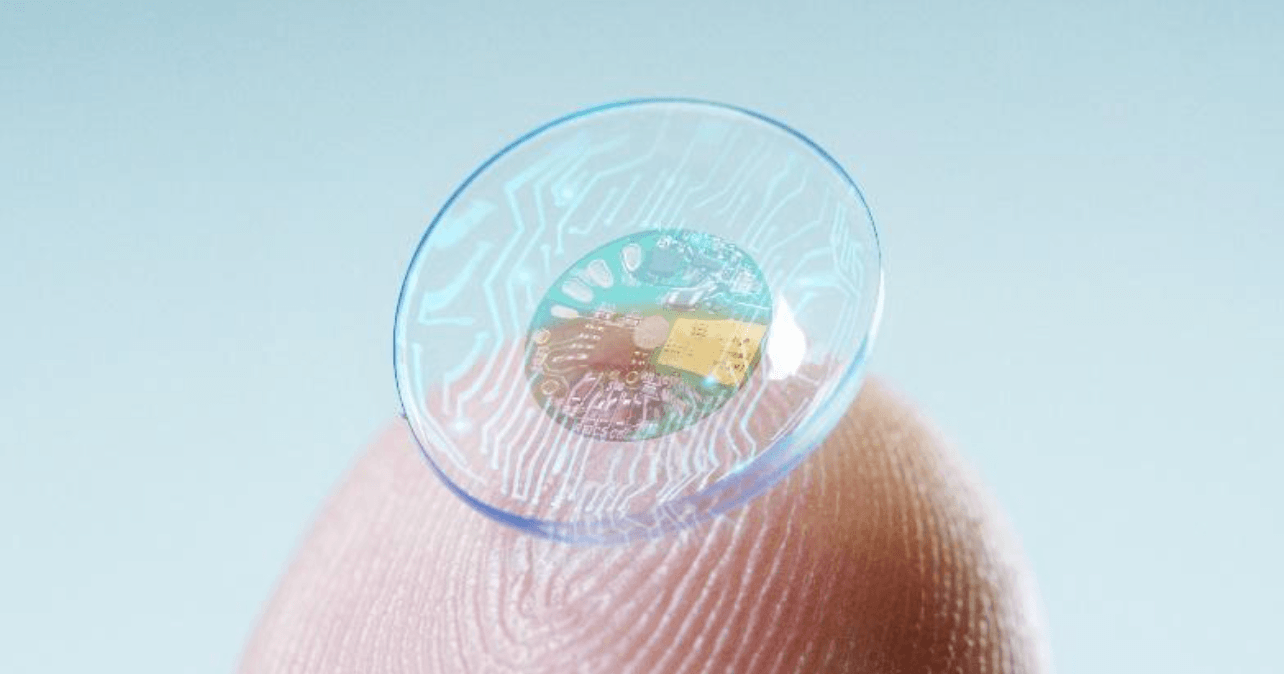
Growing demand for thinner, lighter, and higher-performing optical components is driving renewed interest in high refractive index materials.
Applications such as intraocular lenses (IOLs), contact lenses, ophthalmic devices, and diagnostic imaging systems rely on materials that provide greater optical power while reducing lens thickness. Optical transparency, low color, long-term stability, and biocompatibility remain critical to achieving consistent optical performance.
Applications Driving Innovation:
- Intraocular lenses (IOLs)
- Contact lenses
- Ophthalmic devices
- Diagnostic imaging components
Optical Coatings & Photonics

Advances in AR/VR, advanced displays, silicon photonics, and optical communications are increasing demand for materials that deliver optical performance while fitting within practical manufacturing processes.
High refractive index materials support light manipulation, can enable waveguide designs with appropriate index contrast, and can improve index matching between adjacent materials, helping reduce Fresnel reflections and optical losses. Formulators continue to seek materials that balance optical performance with manufacturability, durability, and long-term reliability.
Applications Driving Innovation:
- UV-curable optical coatings
- Diffractive optical elements
- Optical films and displays
- Waveguides
- Silicon photonics
- Precision optical components
Technical Spotlight
BIMAX® PEMA & BIMAX® POEA: Aromatic Building Blocks for Advanced Optical Materials
Smaller, more sophisticated optical systems require materials that increase refractive index without sacrificing transparency, processability, or long-term performance.
Aromatic (meth)acrylate monomers provide a practical approach to increasing optical performance while maintaining the processing advantages of organic materials. Their aromatic phenyl groups increase molecular polarizability, contributing to higher refractive indices without the need for inorganic fillers.
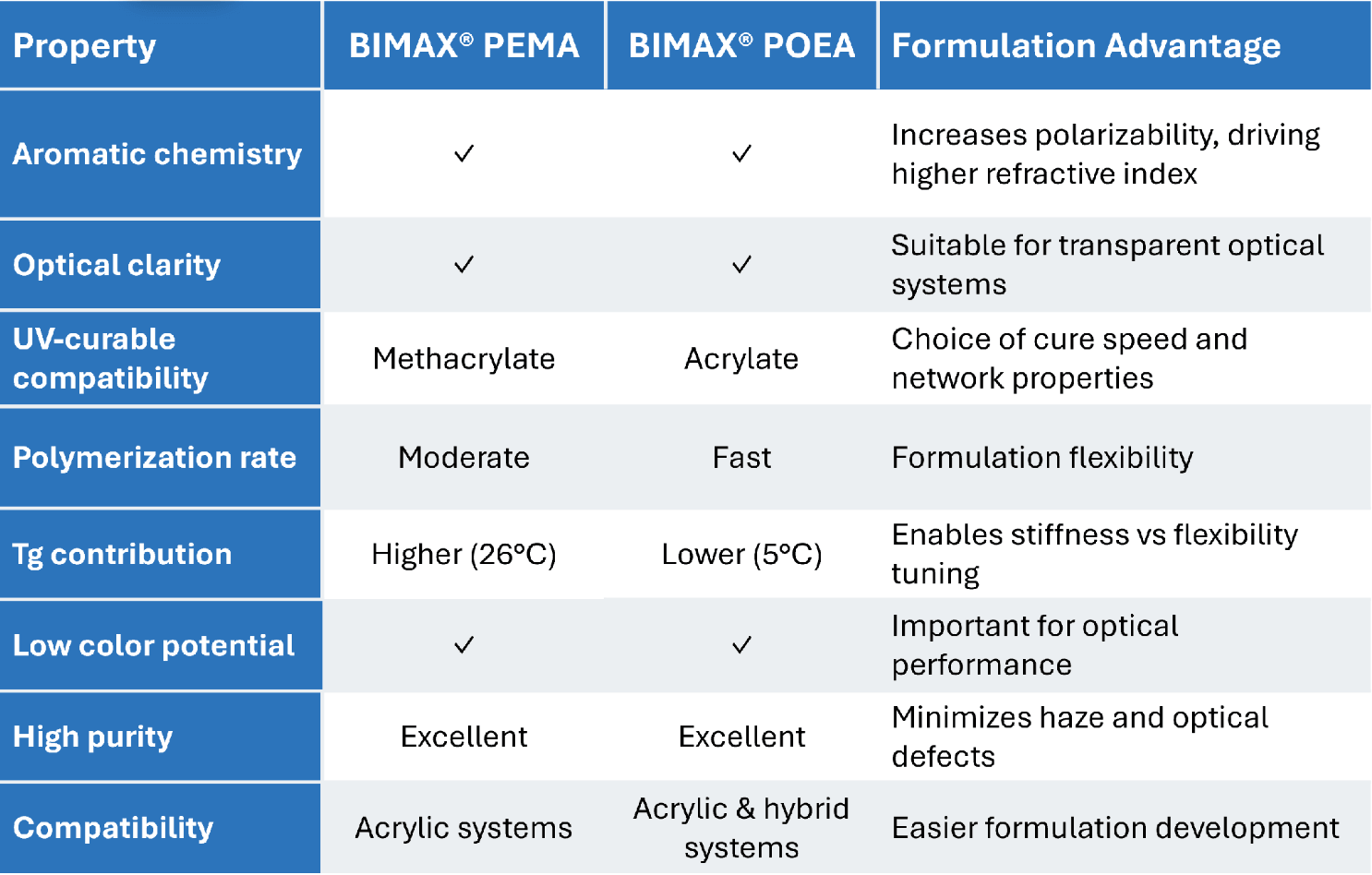
Gelest’s BIMAX® PEMA and BIMAX® POEA provide complementary aromatic building blocks for ophthalmic, photonic, and UV-curable optical formulations. While both increase refractive index through aromatic chemistry, each offers a distinct balance of cure chemistry, mechanical properties, and formulation flexibility.
Structure-Property Relationship
- Aromatic phenyl groups increase molecular polarizability.
- Higher polarizability increases refractive index.
- Higher refractive index enables thinner optical components, improved light management, and greater optical design freedom.
Performance in Practice
BIMAX® PEMA is well suited for ophthalmic materials where optical transparency, dimensional stability, and high purity are critical. Its moderate glass transition temperature provides greater rigidity while maintaining the refractive index needed for thinner optical components.
BIMAX® POEA offers a higher refractive index together with a lower glass transition temperature and acrylate functionality compatible with rapid UV-curable systems. These characteristics make it attractive for UV-curable optical coatings, photonic materials, and other formulations requiring greater flexibility and processing latitude.
Together, BIMAX® PEMA and BIMAX® POEA provide complementary aromatic building blocks that allow formulators to tailor refractive index, cure behavior, mechanical performance, and processing characteristics for a wide range of advanced optical materials.
Interested in learning more?
Explore the Technical Data Sheets for BIMAX® PEMA and BIMAX® POEA, or contact Gelest’s technical team to discuss how these aromatic building blocks can support your next optical formulation.
Application Spotlight
UV-Curable Optical Coatings: Enabling High Performance Without Compromising Processability
Demand for advanced optical coatings continues to grow with expanding applications in AR/VR devices, advanced displays, optical sensors, and photonic technologies.
These coatings improve scratch resistance, reduce surface reflections, protect optical components, and optimize light transmission across a broad range of glass and polymer substrates.
Modern optical coatings require a demanding combination of properties, including high refractive index, excellent transparency, rapid UV cure, and long-term durability. Beyond refractive index, coating developers must also balance viscosity, cure kinetics, compatibility with other formulation components, coating stress, adhesion, and dimensional stability throughout the curing process.
BIMAX® POEA (2-Phenoxyethyl Acrylate) was developed to support these UV-curable optical formulations by combining a relatively high refractive index (1.516) with a low glass transition temperature (5°C).The relatively low glass transition temperature can contribute flexibility to cured networks while allowing formulators to tailor modulus through co-monomer selection.
Design Considerations
Selecting a high refractive index monomer involves balancing multiple optical, processing, and mechanical requirements. Key considerations often include:
- Refractive index and optical transparency
- Cure speed and photoinitiator response
- Compatibility with other monomers and oligomers
- Flexibility versus hardness
- Long-term environmental stability
BIMAX® POEA provides formulators with another option for balancing these properties in UV-curable optical systems.
Long-term performance depends on achieving the right balance of optical, mechanical, and processing characteristics.
Upcoming Events
Connect with our technical team at the following industry events to discuss materials innovation, application challenges, and performance-driven solutions across our core markets:
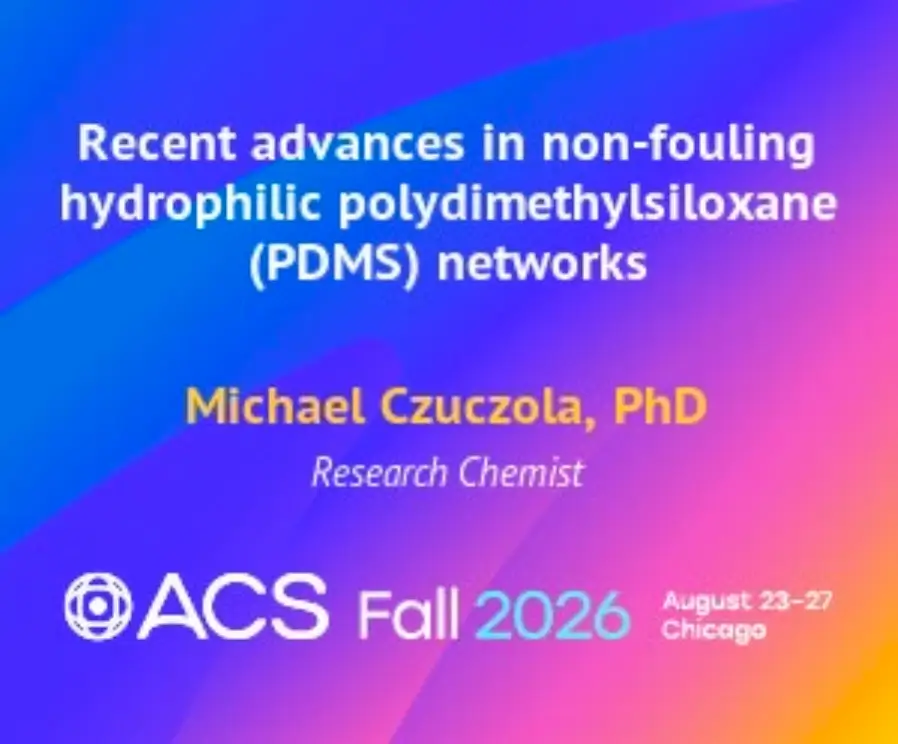
ACS Fall – American Chemical Society
- 23 – 27 August 2026
- Chicago, IL USA
Conference Presentation:
Recent advances in non-fouling hydrophilic polydimethylsiloxane (PDMS) networks
-
- Michael Czuczola, PhD, Gelest Inc.
- August 24, 2026 | Time TBD
- Room & Location: S401bc – McCormick Place Convention Center

-
-
- 2 – 4 September 2026
- Taipei, Taiwan
- Visit us at booth #L0900
-